


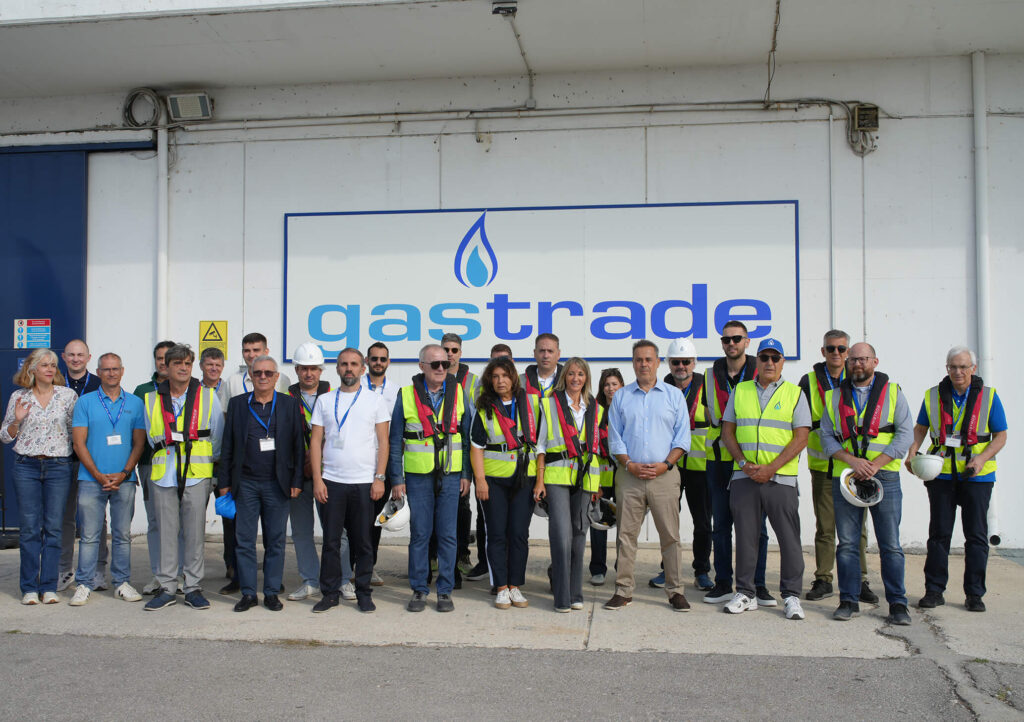
Today, Thursday 3 September, the Alexandroupolis LNG Terminal welcomed representatives of the Natural Gas System Operators (SOs) participating in the Vertical Corridor Initiative, including NOMAGAS of North Macedonia and Transportgas Serbia of Serbia.
The visit took place ahead of the signing of the Memorandum of Understanding (MoU), which will expand participation in the Initiative to include the two new countries, further strengthening cooperation among the energy markets of Southeast and Central Europe and creating the conditions for the development of new natural gas transmission routes to the markets of the Western Balkans.
During the visit, the SOs received a detailed briefing on the Terminal’s operations and capabilities, its contribution to regional energy security and resilience, its role in the development of new supply routes, as well as the high safety and environmental protection standards governing its operation.
At Gastrade’s facilities at the Port of Alexandroupolis, the SOs also met with the Minister of Environment and Energy, Mr. Stavros Papastavrou, who once again highlighted the strategic importance of the FSRU Alexandroupolis for national and European energy policy and security, and expressed the Greek State’s continued support for initiatives that strengthen Greece’s role as an energy gateway to Southeast and Central Europe.
Later that afternoon, the SOs held a working meeting focused on finalising the agreement for the expansion of the Memorandum of Understanding, which will formally welcome North Macedonia and Serbia.
The meeting was addressed by the U.S. Department of Energy’s Special Envoy, Mr. Joshua Volz, who highlighted the importance of regional cooperation and the development of energy infrastructure that contributes to the European Union’s complete phase-out of Russian natural gas through the diversification of supply sources and routes, while also contributing to the development of a more resilient European energy system.
The Alexandroupolis LNG Terminal is a key infrastructure asset and an entry point for the Vertical Corridor, contributing to its efficient and competitive operation.
The participation of North Macedonia and Serbia marks a critical step towards the completion of the Vertical Corridor and its expansion to the markets of the Western Balkans. At the same time, it provides new alternative energy routes to landlocked Central European markets, such as Hungary and Slovakia, enabling them to diversify their sources of supply more rapidly through access to natural gas from the global market.